
AI Website Builder for Small Business: An Honest Guide (2026)
AI can build your small business site in minutes — but it'll look like everyone else's. Here's how to pick the right builder and fix what breaks after launch.
5 minute read

Team at OhhWells
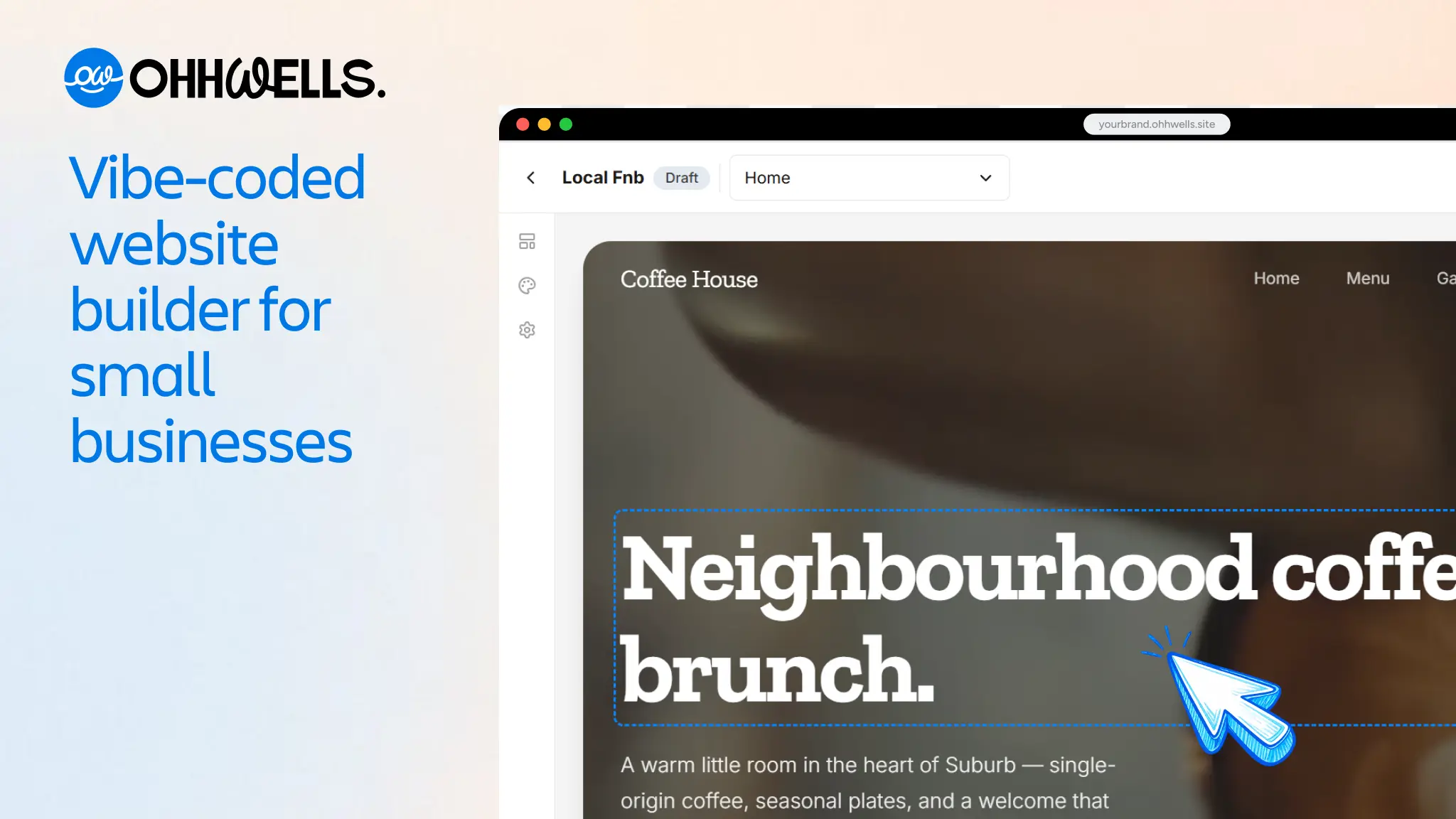
An AI website builder turns a short business description into a working site — layout, copy, images — in minutes, for RM50–200 a month. But
the real question in 2026 isn't whether to use one — it's which tool fits your business, since most produce the same generic design and skip real booking flows for service businesses.
Key takeaways
- AI website builders can generate a complete small business site in under ten minutes for RM50–200 a month, but they don't know your brand or your customers.
- Every AI builder draws from the same design conventions, so businesses in the same category often end up with near-identical sites — a conversion problem, not just a cosmetic one.
- Most AI builders bolt on a calendar widget rather than a real booking system; service businesses that live on appointments need deposits, reminders, and real-time availability, not a contact form.
- Choose the tool by business type: ecommerce fits Shopify or Wix, speed-first launches fit Durable or Hostinger, design-led owners fit Framer, and booking-dependent service businesses need booking-first platforms like OhhWells.
- Before promoting a new AI-generated site, score it with a conversion audit, rewrite the placeholder copy in your own voice, and wire up a real booking flow — fixing brand and booking matters more than which tool you picked.
An AI website builder is a tool that generates a complete small business website — layout, copy, and images — from a short description of your business, usually in under ten minutes and for RM50–200 a month instead of the thousands a custom build costs. In 2026, they work. The real question is no longer whether to use one. It's which one fits your business, and what to do about the problem every single one of them shares: the sites look the same.
This guide answers both — written for small business owners, not developers or agencies.
What an AI website builder actually does (and doesn't)
Does: turns a prompt like "I run a pilates studio in Singapore with class bookings" into a working multi-page site — hero, services, about, contact — with placeholder-quality copy and stock-adjacent imagery. Most handle hosting, mobile layouts, and basic SEO tags automatically. The AI website builder market is projected to reach roughly $6.3 billion in 2026, and adoption among small businesses is near-universal.
Doesn't: know your brand. The AI has never met your customers, doesn't know why people choose you over the studio two streets away, and defaults to the same design patterns for every business in your category. It also rarely handles the business layer well — real booking flows, deposits, class schedules, follow-up — as opposed to a "Contact Us" form.
That gap is where most small business owners get stuck three weeks after launch: the site exists, but it doesn't convert, and it doesn't feel like them.
How to choose: match the tool to your business type
Skip the "8 best" listicles for a moment. The right choice depends on what kind of small business you run:
| Your situation | What you need | Tool lane |
|---|---|---|
| Selling products online | Store, checkout, inventory | Ecommerce-first builders (Shopify AI, Wix) |
| Service business that lives on bookings (studio, salon, tutor, therapist, consultant) | Real scheduling, deposits, reminders — not a contact form | Booking-first platforms (this is OhhWells' lane) |
| Testing an idea this weekend | Speed above all | Instant generators (Durable, Hostinger AI) |
| You care deeply about design and have time to tinker | Fine control | Designer tools (Framer, or vibe coding tools like Lovable) |
| One-page campaign or launch | A single high-converting page | AI landing page generators |
Two honest notes on that table. First, the big names are big for a reason — Wix's AI has been iterating since 2016 and its app ecosystem is unmatched. Second, the "vibe coding" tools (Lovable, v0, Bolt) genuinely produce impressive sites, but they hand you code to maintain — fine for technical founders, a trap for most small business owners. We've written separately about what vibe-coded websites look like in practice.
The five checks before you commit
- Booking depth, not booking checkbox. If appointments are your revenue, test the actual flow: can a customer pick a slot, pay a deposit, and get a reminder — without you emailing them manually? Most AI builders bolt on a calendar widget and call it done. (We've broken down what a real website builder with booking system includes.)
- Can you edit without fear? Generate the site, then try changing the headline, swapping a photo, and adding a page. If that takes a tutorial, it will take a support ticket in six months.
- Who owns what? Check whether you can export your content, connect your own domain, and leave without rebuilding from zero.
- Real cost after the intro price. Advertised prices are usually annual-billing teaser rates; renewal often doubles. Budget on the renewal price.
- What happens after launch? This is the check nobody lists — and it's the one that decides whether the site makes you money.
The problem no AI builder solves: your site looks like everyone else's
Here's what even the tools' own comparison articles admit: AI builders tend to produce designs that look alike and struggle with specific branding requirements. It's structural, not a bug. Every AI builder is trained on the same design conventions, so every pilates studio gets the same sage-green serenity template, every consultant the same navy-and-white grid.
For a small business, that's not a cosmetic issue — it's a conversion issue. Your website's job is to make a stranger feel, in about five seconds, that you're the obvious choice. A site that could belong to any of your competitors can't do that job, no matter how fast it was generated.
We call the fix brand conversion: taking a functional website and making it unmistakably yours — your voice in the copy, your visual identity in the design, and conversion mechanics (clear offer, trust signals, one obvious next step) built into every page. It's the layer AI generation skips, and it's the layer OhhWells exists to add.
A realistic playbook for a small business owner
- Generate the bones with AI. Any of the tools above will get you a working site in a day. Don't over-deliberate here.
- Score it before you promote it. Run the free OhhWells Website Audit — it checks your site across 6 dimensions and 30 conversion checkpoints and gives you a Conversion Score, so you know exactly what's generic, what's missing, and what to fix first. Takes about two minutes.
- Fix brand before traffic. Rewrite the AI's placeholder copy in your own voice, replace the stock-adjacent imagery, and make one action unmissable on every page (book, call, buy). Spending on ads before this step is paying to send strangers to a site that doesn't convert them.
- Wire up the money path. For service businesses: real bookings with deposits and reminders. This alone separates you from the majority of AI-generated sites still running on contact forms.
- Re-score monthly. Your Conversion Score gives you a number to move — far more useful than staring at the site wondering if it's "good."
Where OhhWells fits (said plainly)
OhhWells is a website platform for small business owners — a website builder plus booking management, built so your site looks unmistakably like your brand and converts visitors into booked customers. If you're a service business in wellness, fitness, or lifestyle, that's our home turf. If you're pure ecommerce, one of the tools above will serve you better — genuinely.
Either way, the free audit works on any site, built with any tool. Run your free Website Audit → and get your Conversion Score plus a prioritized fix list by email.
What is the best AI website builder for a small business?
There's no universal best — it depends on your business type. Ecommerce businesses fit Shopify or Wix; speed-first launches fit Durable or Hostinger; design-led owners fit Framer. Booking-dependent service businesses (studios, salons, tutors, therapists) need booking-first platforms like OhhWells, because a calendar widget isn't a booking system.
Are AI website builders good enough for a real business?
Yes — for launching. AI builders reliably produce a working, mobile-friendly site in minutes. Where they fall short is after launch: generic design, placeholder-grade copy, and weak booking/conversion mechanics. Plan for a branding-and-conversion pass on whatever the AI generates.
Why do AI-generated websites all look the same?
Because every AI builder learns from the same pool of design conventions and applies the same defaults per industry. The output is competent but interchangeable. Fixing it requires a deliberate brand layer — your voice, your visual identity, and conversion structure — on top of the generated site.
How much does an AI website builder cost for a small business?
Typically RM50–200 (US$15–50) per month, versus thousands for a custom-built site. Watch renewal pricing: advertised rates are usually first-term teasers that increase significantly on renewal. Budget on the renewal price, not the intro price.
Can an AI website builder handle appointment bookings?
Some can, superficially. Most offer a calendar embed or contact form rather than a true booking system with real-time availability, deposits, and automated reminders. If bookings are your revenue, test the full booking flow before committing — or choose a platform where booking is native, not an add-on.
How do I know if my AI-built website is any good?
Measure it instead of guessing. A conversion audit checks the things that make visitors act: clear offer, trust signals, mobile experience, calls-to-action, booking path. OhhWells' free Website Audit scores any site across 49 checkpoints and returns a Conversion Score with a prioritized fix list.
Related articles
Best Free Website Audit Tools for Small Businesses
9 free tools, one big blind spot. Here's what each one checks — and the one thing none of them tell you.